

![Taste around Kyoto [Kiyomizu-dera Temple]! Recommended Lunch](https://www.leafkyoto.net/leaf/wp-content/uploads/2023/10/231024-kiyomizutera-lunch-300x200.jpg)
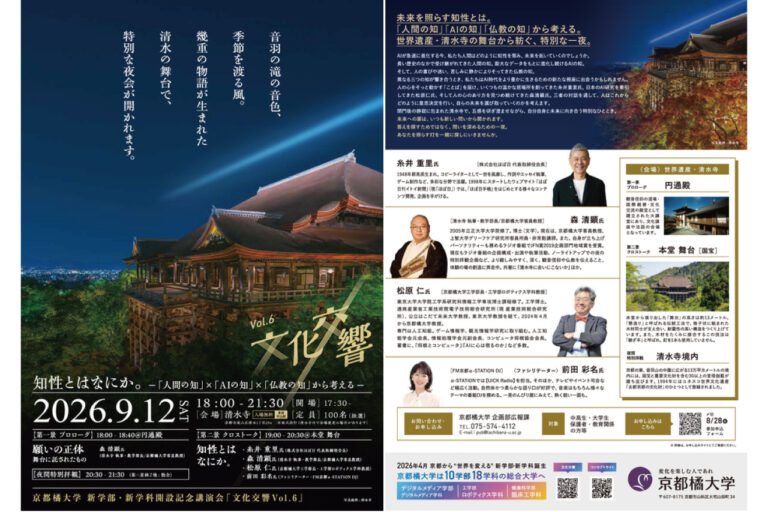
Special Nighttime Viewing / Kiyomizu Temple



Kiyomizu-dera Temple is the head temple of the Northern Hoso sect of Buddhism, located at the foot of Higashiyama (Mt. Higashi). It is one of the representative temples of Kyoto, and is the focus of much attention due to the completion of major renovations in 2020, including the re-thatching of the roof of the main hall and the replacement of the stage boards. The temple is also known for its cherry blossoms and autumn foliage, with mountain cherry trees and Someiyoshino cherry trees in full bloom from late March to early April, and maple trees and mountain maples decorating the temple grounds from mid-November to early December.
We will introduce tips on how to enjoy visiting the temple precincts, from the standard attractions such as the Kiyomizu-no-butai and Otowa-no-taki waterfalls to mysterious sights to look for and find, as well as red seals and gifts available at each sutra office. Check also for information on popular events and access to the temple.
Founded in 778 by Enchin Shonin and later by Sakagami Tamuramaro, the two met in the summer of 780. Tamuramaro was on a deer hunting trip to Higashiyama in search of medicinal food to ease his wife's childbirth, and stopped by Otowa Falls to quench his thirst, where he encountered Enchin. Tamuramaro was so moved by Nobuchin's words that he was willing to take another's life in order to pray for an easy delivery that he was so moved that he created and donated the Kannon Hall to the temple, thus marking the beginning of Kiyomizu-Dera Temple.
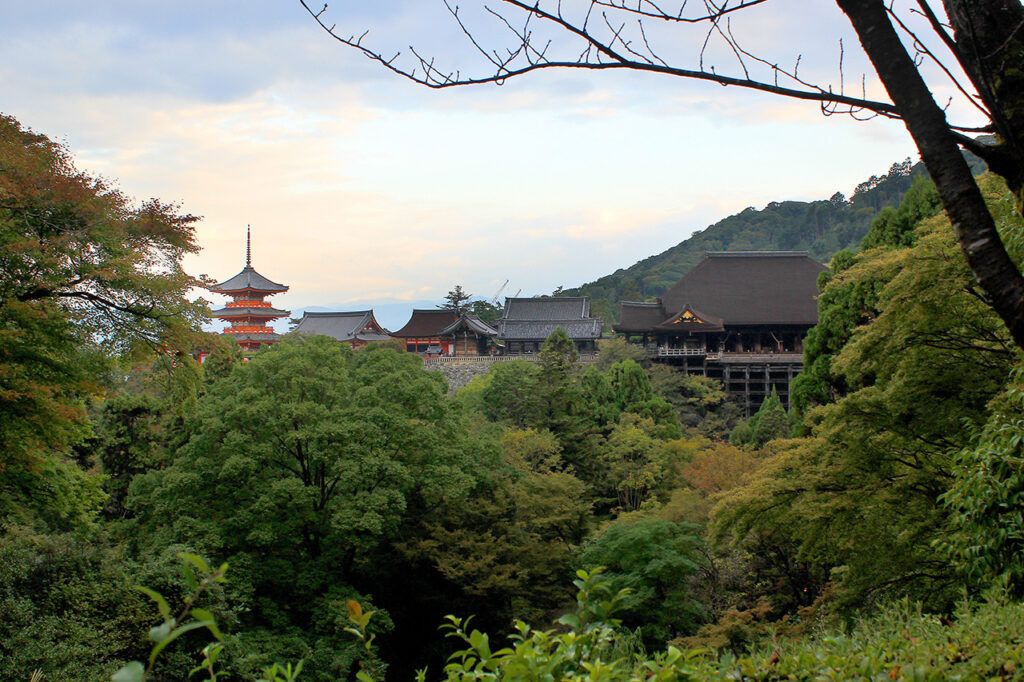
In the Heian period (794-1185), Tamuramaro was appointed as a barbarian general to defeat the Emishi in the eastern part of Japan. He won a victory through Enchin's prayers and built a temple with a golden eleven-faced thousand-armed Kannon as its principal image as a reward.
Since then, the temple has been destroyed by fire more than 10 times due to calamities, including being burned down in a power struggle and burned down during the Onin War. Each time, the temple and the people worked together to rebuild the temple, and the temple's present form is the result of this history.
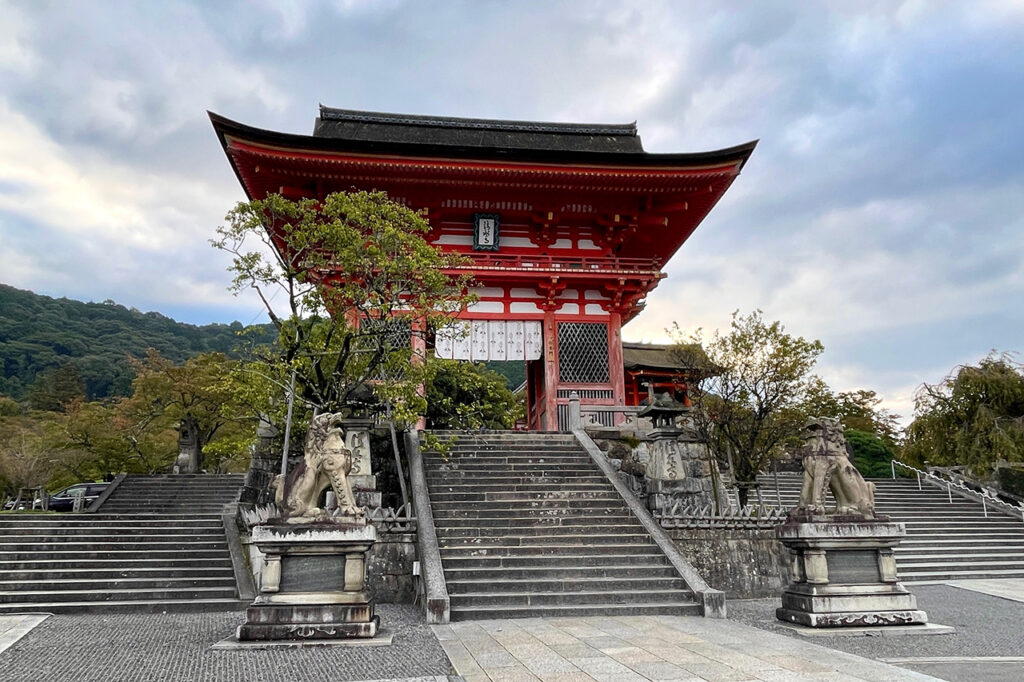
Deva Gate
After passing through the busy Sanneizaka Street, the first thing that greets you is the Niomon Gate, the main gate of Kiyomizu-Dera Temple. [It is the main gate of Kiyomizu-dera Temple and is also called "Akamon" (red gate) due to its beautiful tan-nuri (red lacquered) appearance. It was destroyed by fire during the Onin War, but was rebuilt around 1500.
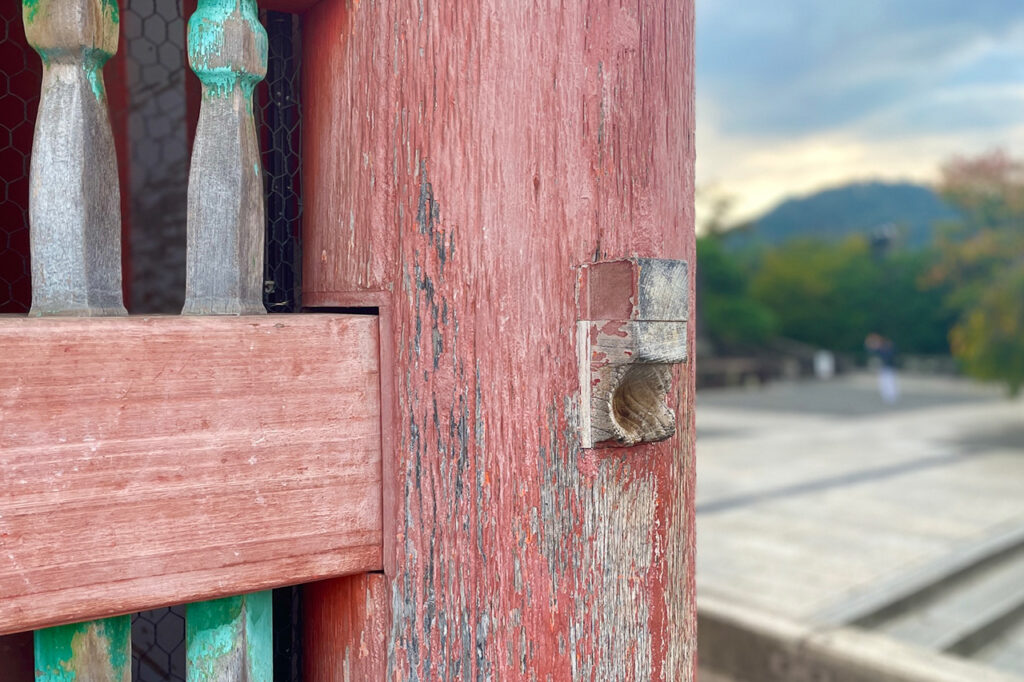
Hollows in the hips
A curious device is that if one taps the hollow of the koshikan on the right side of the front of the Niomon gate with a fingertip, the sound is transmitted diagonally to the opposite side of the gate. The hollowed-out state of the gate suggests that a large number of people tapped on it.
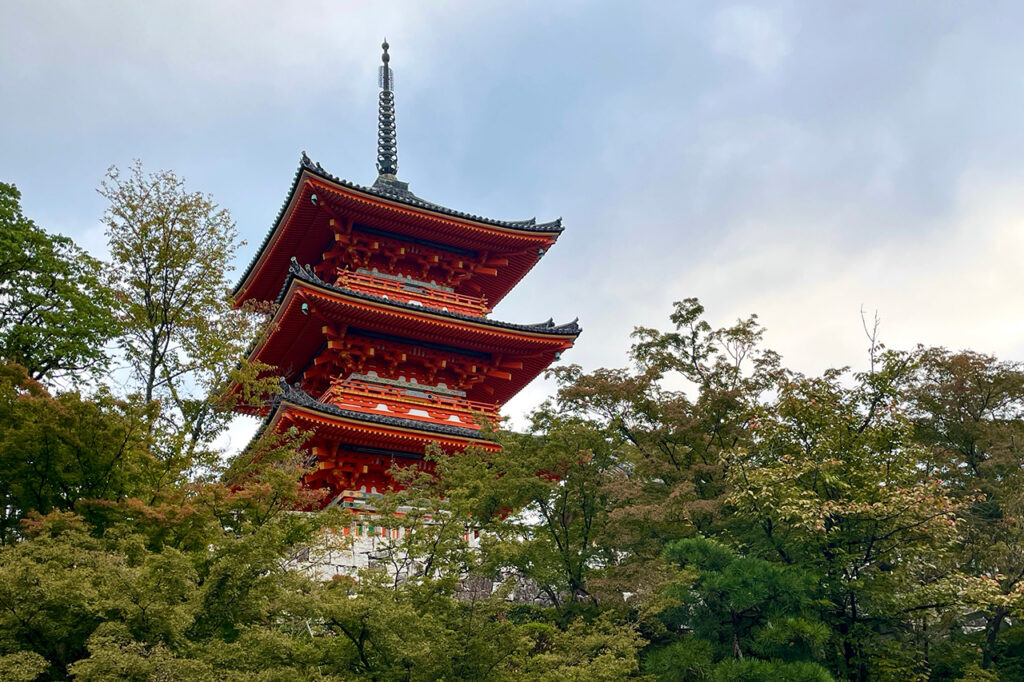
three-storied pagoda
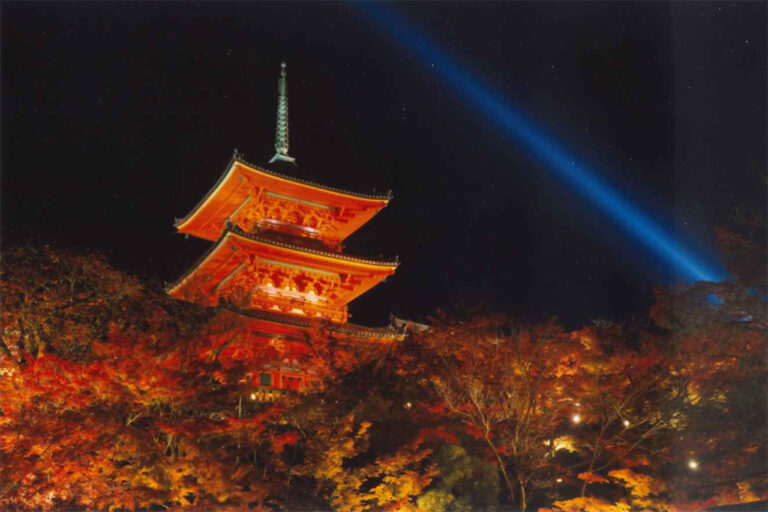
Founded in 847, the current building was rebuilt in 1632. It is one of the largest three-story pagodas in Japan and has become a symbol of Shimizu, as it is clearly visible from the city.

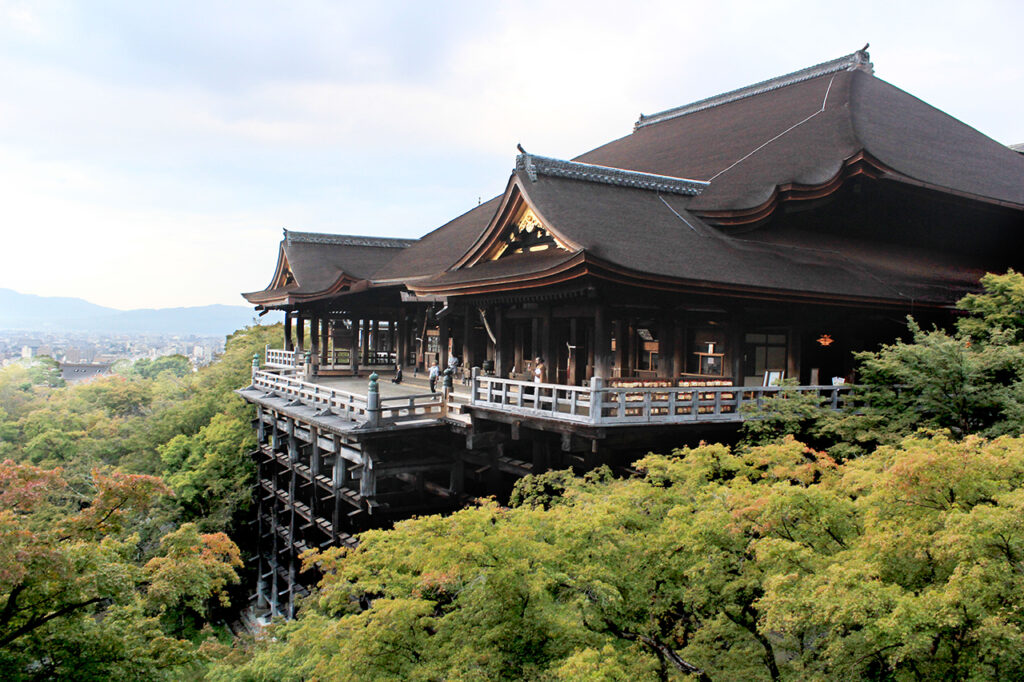
The stage of Kiyomizu is supported by a traditional Japanese construction method called kake-zukuri.
The main hall stands on a cliff and has a stage known for the proverb "jumping down from the stage of Kiyomizu," and during a major renovation completed in 2020, the stage boards were replaced with new cypress boards, giving it a shiny new look. The stage is approximately 13 meters high. The architectural beauty of the latticework, built around huge zelkova pillars using only zelkova staves and wedges, without the use of nails, is a sight to behold. In the old days, there was a custom to actually jump off the stage in the belief that one's wish would be fulfilled if one risked one's life to believe in the Gohonzon.
Enshrined in the inner sanctuary at the far end of the temple, as seen from the stage, is a statue of the eleven-faced thousand-armed Kannon, the principal deity of the temple, which is said to have been taken out of the temple every time it was destroyed by fire. With eleven faces and forty-two hands, the statue expresses great compassion and has long been believed to save people from suffering. Because it is a secret statue, the door to the kitchen is usually closed, and it can only be seen in person once every 33 years; the next time will be in 2033. However, visitors can see the Buddha in an omae-dachi (standing in front of the main image), which is a replica of the main image. In addition, a special viewing of the inner sanctuary is possible during the annual Sennichimairi (pilgrimage) held from August 9 to 16.
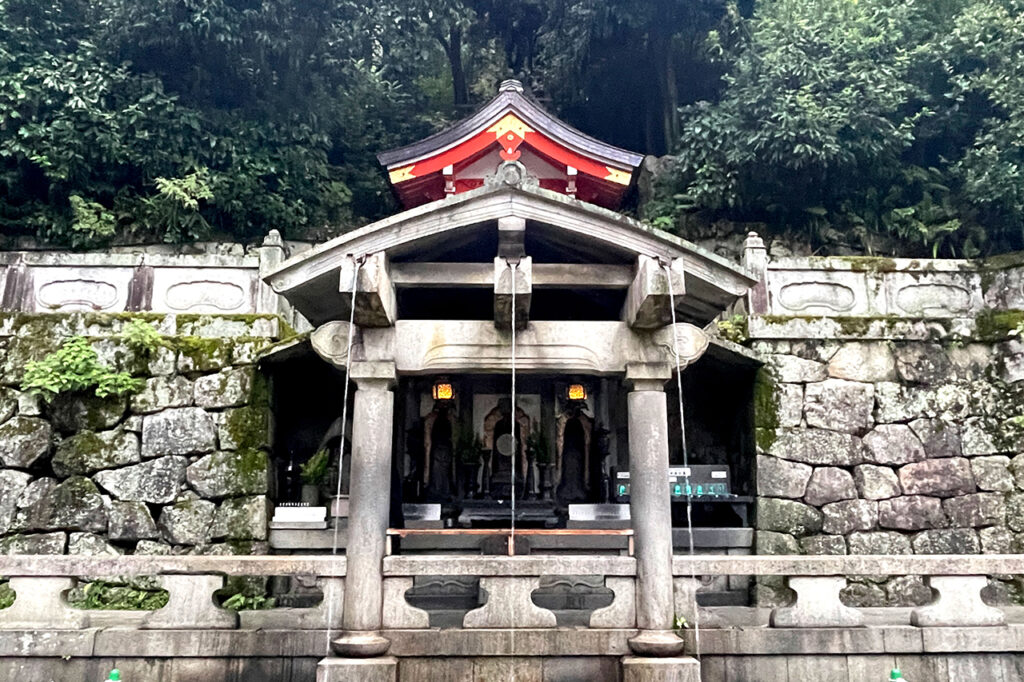
Otowa Falls
This is the water where Tamuramaro quenched his thirst and where he first met Enchin. [Otowa Falls, from which the temple's name "Kiyomizu-dera" is derived, is pure water that has been gushing out since prehistoric times. Originally a single waterfall, it has been worshipped as "golden water" of Kannon, the Goddess of Mercy, and as "water that prolongs long life. According to folk belief, it is believed to be beneficial for wealth and fortune, the fulfillment of a good marriage, and the prolongation of one's life.

Over 600 interviews per year! An order site carefully selected by the editors who knows Kyoto and Shiga.
nowOfficial LINE friend registration500 yen OFF coupon is being issued!

Distributed every Friday morning at 8:00 am! From new restaurant information to event information that we want to share with you, We deliver articles about Kyoto that are useful to know. About 20,000 people have registered.Click here to add a friend!
 News
News Feature article
 Featured event
![安藤忠雄建築[TIME'S]京都建築センター](https://www.leafkyoto.net/leaf/wp-content/uploads/2026/08/260807-times1-300x200.jpg)