A new hotel with 270 rooms, [Courtyard...], just a 3-minute walk from Kyoto Station...


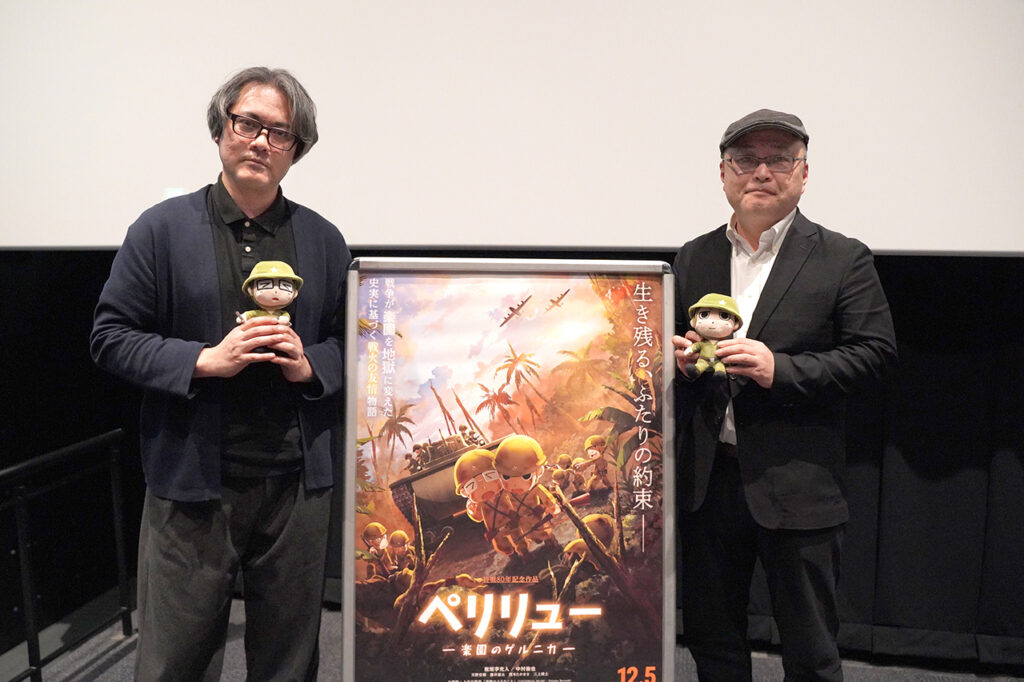
(From left in the photo) Manga artist Kazuyoshi Takeda and Kazuma Yoshimura, professor at Kyoto Seika University

The manga *Peleliu: Guernica of Paradise*, which depicts the “Battle of Peleliu” during World War II, is being adapted into a theatrical anime. The original work is a popular series by Kazuyoshi Takeda, who won the Excellence Award at the Japan Cartoonists Association Awards. Set in Showa 19, as the war situation worsened, it realistically depicts young soldiers struggling to survive in an extreme tropical environment while battling hunger, thirst, and infectious diseases. Set on a brutal battlefield where only 34 out of 10,000 soldiers survived, the film poignantly portrays the friendship and inner conflicts of soldiers fighting while thinking of their families and hometowns. Ryokuto Itagaki delivers a passionate performance as the protagonist, Tamaru, while Tomoya Nakamura plays his partner, Yoshiki.
Ahead of the film’s nationwide release, a teach-in screening of *Peleliu: Guernica in Paradise* was held at [T-Joy Kyoto]. This event was organized in response to a request from the [Kyoto International Manga Museum], which was hosting the “Manga and War Exhibition 2” featuring the film. On the day of the event, Mr. Takeda, the original author and co-screenwriter, and Mr. Kazuma Yoshimura (Professor at Kyoto Seika University), the curator of “Manga and War Exhibition 2,” took the stage. They discussed the creative background of the film and the behind-the-scenes story of the character designs, providing the audience with a valuable opportunity to delve deeper into the film’s world.
To date, When I asked Ms. Takeda—who has previously published manga depicting her own circumstances, such as *Goodbye, Tama-chan* and *Oyakokko*—why Ms. Yoshimura decided to take on the new genre of war manga, she explained that, as a member of a generation that had not experienced war firsthand, she had struggled with the question, “Is it even appropriate for me to draw this?” However, after immersing herself in works by manga artists who had direct wartime experience—such as Shigeru Mizuki’s *All Hands, Charge to the Death*— as well as works by manga artists who had direct experience of the war—such as Fumiyo Kono’s *In This Corner of the World* and Yuki Ozawa’s works—and that she felt “encouraged” by the presence of those who had continued to depict the war generation after generation.
This time, Mr. Takeda took a bold step by depicting a brutal battlefield through cute, three-headed characters—a daring challenge. When Mr. Yoshimura asked, “Wasn’t that a choice that took courage?” Mr. Takeda revealed, “The methodology I developed while working on *Goodbye, Tama-chan* was the foundation for this.” Even while depicting a harsh reality, the soft character designs soothe readers’ hearts and make the story easier to accept. This is because he had already experienced that effect firsthand.
In particular, the expression of Private Tamaru—the protagonist and aspiring manga artist—with his eyes narrowed became a key design element that shaped the overall impression of the work. Takeda reflects that it was “an expression that arose naturally as an extension of the emoticons used on cell phones and other devices.” Rather than depicting emotions excessively, the artwork leaves room for readers to project their own feelings. This restraint was said to be ideal for Tamaru, who constantly witnesses the harsh realities of the battlefield. In contrast, Private First Class Yoshiki is depicted as a character with large, shonen-manga-style eyes, creating a composition that further emphasizes the harsh reality he faces.
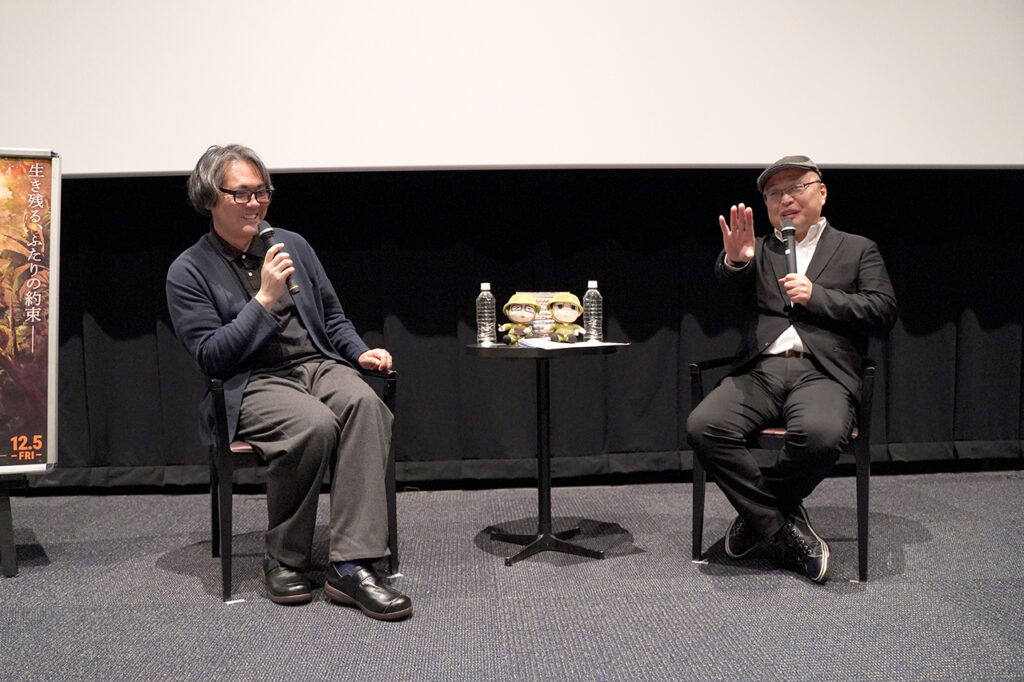
When the conversation turned to the challenges of character design, Takeda gave a wry smile and said, “It was really hard to distinguish the characters using the three-head-height proportion.” With all the characters wearing identical military uniforms, he had to distinguish them solely by their faces, and the policy of avoiding “mob characters” (i.e., generic background characters) further increased the difficulty. However, he noted that Private First Class Koyama—whose face was deliberately designed to look like a “run-of-the-mill” mob character—made the story feel even more relatable, as it showed that “this could happen to anyone.” Regarding “characters I’m attached to,” he said, “I like them all,” but cited Private Second Class Takagi as a character who unexpectedly became important to him. “He’s useless—more of a hindrance, really—but I realized that if I were actually on the battlefield, I might be just like Takagi,” he explained, noting the overlap between himself and Takagi, and added, “I felt I had to portray this character properly.”
As for Rihito Itagaki, who voiced Tamaru in the film, Takeda was thrilled—even though he had strongly requested Itagaki for the role—noting that “there were several moments where his performance exceeded my expectations.” Tomoya Nakamura, who voiced Yoshiki, revealed his surprise, saying, “I thought the character would come across as cool if played by someone cool, but the image of a ‘reliable older brother from the countryside’—which was part of Yoshiki’s background but hadn’t been discussed in our meetings—naturally shone through in Nakamura’s voice.”
The original manga consists of 11 main volumes and 4 spin-off volumes, for a total of 15 volumes. Mr. Takeda, who pored over a vast amount of source material and persistently tracked down testimonies from those involved, reflects, “The spin-offs, in particular, took a long time; I could only complete one volume a year.” It is precisely because he has engaged with each individual life and painstakingly unearthed their memories that the everyday lives that were certainly there breathe with life from within the pages.
Although the filmmakers chose to portray the horrors of wartime through cute characters, this film serves as a gateway for us—who live in the present and have no firsthand experience of war—to feel the very breath of the young people who lived through that era and to pass those sentiments on to the next generation. Eighty years after the war. I hope you’ll go to the theater to experience what this story has to say.
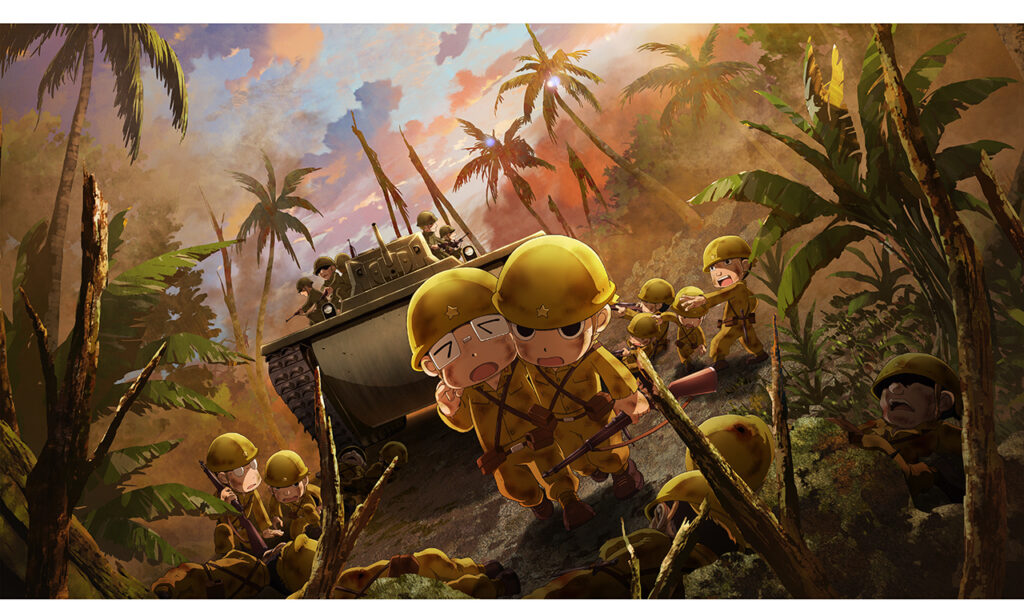
© Kazuyoshi Takeda, Hakusensha / 2025 “Peleliu: Guernica of Paradise” Production Committee

Over 600 interviews per year! An order site carefully selected by the editors who knows Kyoto and Shiga.
nowOfficial LINE friend registration500 yen OFF coupon is being issued!

Distributed every Friday morning at 8:00 am! From new restaurant information to event information that we want to share with you, We deliver articles about Kyoto that are useful to know. About 20,000 people have registered.Click here to add a friend!
 News


PR

 Feature article


PR


 Featured event