[2026] It's Not Just About the Food Stalls! Locals Share Their Tips on "Gion...".


The Gion Festival in Kyoto, one of Japan’s Three Great Festivals, boasts a history of over 1,000 years. It is a religious ceremony held at [Yasaka Shrine] (Higashiyama Ward, Kyoto City, Kyoto Prefecture) to pray for the warding off of epidemics, and various festival events take place throughout the month of July each year. The highlight of the festival is the “Yamahoko Procession.” Here, we’ll introduce everything from basic information about the Yamahoko Procession to recommended viewing spots. Enjoy the Gion Festival, which brings color to Kyoto’s summer, to your heart’s content. (TEXT/Kana Hosoya, PHOTO/Sayori Takeshita, EDIT/Miki Tamura)
The “Yamahoko Procession,” the highlight of the Gion Festival, is an event in which 34 yamahoko parade through the city to ward off misfortune and pray for good health and safety. The magnificent yamaboko, adorned with beautiful embroidery and imported textiles, are known as “moving art museums” due to their stunning beauty. The “Yamaboko Procession of the Kyoto Gion Festival” has also been designated as a UNESCO Intangible Cultural Heritage.

Scenes from the Kangoku-boko Procession
The order of the Yamahoko floats in the procession is determined by the “lot-drawing ceremony” held on July 2. This ceremony is said to have begun during the Muromachi period to avoid disputes over the procession order, and is now solemnly conducted in the council chamber of the [Kyoto City Hall] in the presence of the mayor. Certain yamahoko, such as the Naginata-boko, have had their order fixed since ancient times and therefore do not participate in the lottery; they are known as “kujitorazu” (those that do not draw lots).
The Yamahoko Procession takes place twice: on July 17 for the Saki-matsuri (Pre-Festival) and on July 24 for the Ato-matsuri (Post-Festival). This is timed to coincide with the Mikoshi Togyo (portable shrine procession), the central ritual of the Gion Festival; the procession held on the day of the Shin-ko-sai (Procession of the Shrine) is called the “Saki-matsuri,” while the one held on the day of the Kan-ko-sai (Return Procession) is called the “Ato-matsuri.” Since different yama-hoko participate in each procession, be sure to check in advance which ones you’re interested in.

Scenes from the Maematsuri and the Hoshōzan Procession

Scenes from the After Festival and the Ofuna-boko Procession
Pre-Festival (July 17) / Naginata-boko, Hangoku-boko, Kikusui-boko, Tsuki-boko, Tori-boko, Hōka-boko, Iwato-yama, Fune-boko, Yamabushi-yama, Mōshō-yama, Taishi-yama, Kakkyō-yama, Hōshō-yama, Abura-Tenjin-yama, Shijō-Kasa-boko, Mantō-yama, Hakuya-yama, Kizō-yama, Arare Tenjin-yama, Bai Juyi-yama, Ashikari-yama, Urade-yama, Ayagasa-boko (23 floats in total)
Late Festival (July 24) / Kita-Kannon-yama, Minami-Kannon-yama, Hashibenkei-yama, En no Gyōja-yama, Koi-yama, Hachiman-yama, Suzuka-yama, Kuro-shu-yama, Jōmyō-yama, Ōfune-hoko, Taka-yama (11 floats in total)
The procession routes for the Maematsuri and Aтомatsuri are different. During the Maematsuri, starting at 9:00 a.m. and led by the Naginata-boko, the procession moves slowly along Shijo Street → Kawaramachi Street → Oike Street, heading toward Shinmachi Oike. During the Later Festival, starting at 9:30 a.m. on the 24th, the procession begins at the Karasuma-Oike intersection, led by the Hashibenkeiyama float, and follows a route opposite to that of the Earlier Festival.
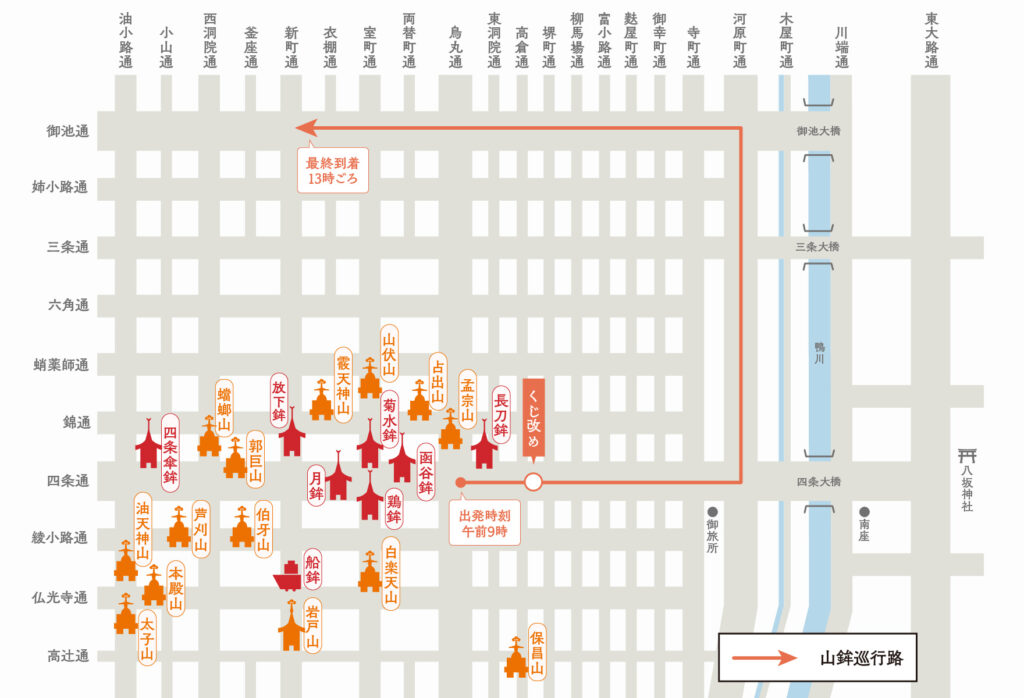
Maegae parade route
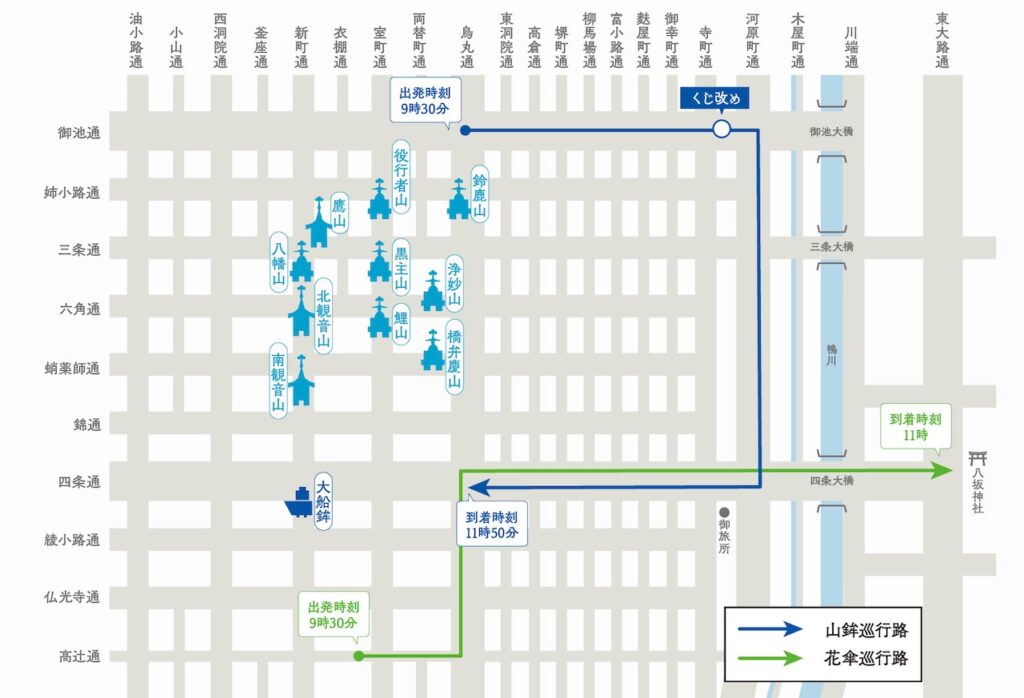
Post-festival procession route
While simply watching the yamahoko floats parade through the streets is a sight to behold, if you’re going to take the time to watch the procession, we recommend enjoying the highlights, such as the “Tsujimawashi,” “Shimenawa-kiri,” and “Kuji-kae.”

The “Tsuji-mawashi” is the highlight of the Yamahoko Procession, where the massive Yamahoko floats make a right-angle turn at an intersection. Water is sprinkled onto long split bamboo poles laid on the ground, and at the lead caller’s command, the pullers give a sudden, powerful tug to rotate the float. The dynamic “Tsuji-mawashi” maneuver of these yamaboko, which weigh over 10 metric tons, is a must-see if you attend the yamaboko parade. You can witness it at the “Shijo-Kawaramachi” and “Kawaramachi-Oike” intersections during both the Ma-matsuri and Ato-matsuri festivals.

Tsukihoko's Turn at the Intersection
One of the highlights of the Pre-Festival is the “Shimenawa-kiri” ceremony, in which a child riding the Naginata-boko—which leads the Pre-Festival procession—cuts the shimenawa (sacred rope) marking the boundary between the sacred and profane realms with a sword. This popular annual ritual takes place at Shijo Fuyacho.

Scenes from the Shimenawa-Cutting Ceremony
The “Kuji-kae” is a ceremony to verify that the procession order of the Yamahoko floats matches the order determined by the “Kuji-tori-shiki” (lottery). The moment when the officials of each Yamahoko float present a box containing the lottery slips to the Mayor of Kyoto, who serves as the magistrate, is a must-see. The ceremony for the First Festival is held at “Shijo Fuyacho,” and for the Second Festival, at “in front of Kyoto City Hall.”

Scenes from the lottery draw at Hoshōzan
"Tsujimawashi," "Shimenawakiri," and "Kuji-kaeme" are the highlights of the parade, so there tends to be a large crowd of spectators. For those who prefer to watch from a spot with fewer crowds, we recommend waiting along Oike Street. Some Yamahoko floats put on performances during the procession, so be sure to come and enjoy the show.

Over 600 interviews per year! An order site carefully selected by the editors who knows Kyoto and Shiga.
nowOfficial LINE friend registration500 yen OFF coupon is being issued!

Distributed every Friday morning at 8:00 am! From new restaurant information to event information that we want to share with you, We deliver articles about Kyoto that are useful to know. About 20,000 people have registered.Click here to add a friend!


 News
 Feature article

PR

 Featured event